
Nixa Directory Collections
Nixa research has a real regional shelf, but it is not one complete local run. Christian County Library is the closest gateway for county microfilm, cemetery, obituary, plat, newspaper, and archive links. The detailed directory holdings are at Springfield-Greene County Library's Library Center. They can supply useful southwest-Missouri context, especially when a family, business, or address crosses markets, but they do not establish that a volume covers Nixa. A Nixa-specific printed run was not located in an official catalog.
| Collection | Years | Where Held | Access |
|---|---|---|---|
| Springfield directories | 1878; 1881–1900 reproductions; 1901–1969 microfilm; 1970–present closed storage | Springfield-Greene Library Center | Early material digitized as copyright allows; later material on site |
| Springfield cross-reference books | 1950–1970 microfilm; 1971–2006 closed storage | Springfield-Greene Library Center | Ask staff; an adjacent-city collection, not a Nixa series |
| Springfield telephone books | 1916–1960 microfilm; 1961–present closed storage | Springfield-Greene Library Center | Use in person or ask staff |
| Digitized Springfield directories | 1890, 1899, 1901–1917, 1919–1920 | Springfield-Greene digital archive | Keyword searchable online |
| Nixa printed directories | Not located in an official catalog | Ask Christian County Library, Library Center, and State Historical Society | Confirm geographic coverage before use |
Closed storage does not mean a volume disappeared, and it does not mean every missing year was never published. It describes the access status recorded for the Springfield collection. For a Nixa name, retain the title page, year, and area stated in the volume before treating a line as local evidence.
Nixa Directory Run Gap
A historical directory can be an excellent clue without being a Nixa record. The official research located Springfield books, telephone books, and reverse listings, but no dedicated printed Nixa series. Keep the locality label with each search result. A Springfield address, a Springfield street index, or an entry tied to Nichols Junction may be highly useful in its own setting while still falling outside the Nixa question.
That caution also applies to address changes. The library documents a Springfield conversion in 1947, not a Nixa conversion. No official Nixa renumbering schedule was located. For an old Nixa reference, compare street aliases, subdivision and lot language, post-office place, and the legal description rather than importing a nearby city's history.
Note: A missing Nixa entry can reflect coverage, spelling, or the kind of book searched, not proof that a person never lived locally.
Nixa Directory Research Routes
The Christian County Library local-history gateway brings together routes to county records on microfilm, Missouri Digital Heritage, State Archives material, historic newspapers, cemetery resources, local obituaries, the 1930 plat book, land patents, census transcriptions, and surrounding library collections. It is a referral path rather than a published shelf list for Nixa directories.
The nearby Library Center at 4653 S. Campbell Ave. in Springfield has the deeper local-history room. Most materials are used there, with photocopiers and microform printers available. Its holdings include Missouri population-schedule microfilm from 1830 through 1930, newspaper microfilm, funeral-home records, local vital, land, and probate indexes, and the Dr. William K. Hall Springfield newspaper index for 1900–2009.
The Christian County Library genealogy page is a useful starting point for a Nixa directory search because it links the county's related evidence together.
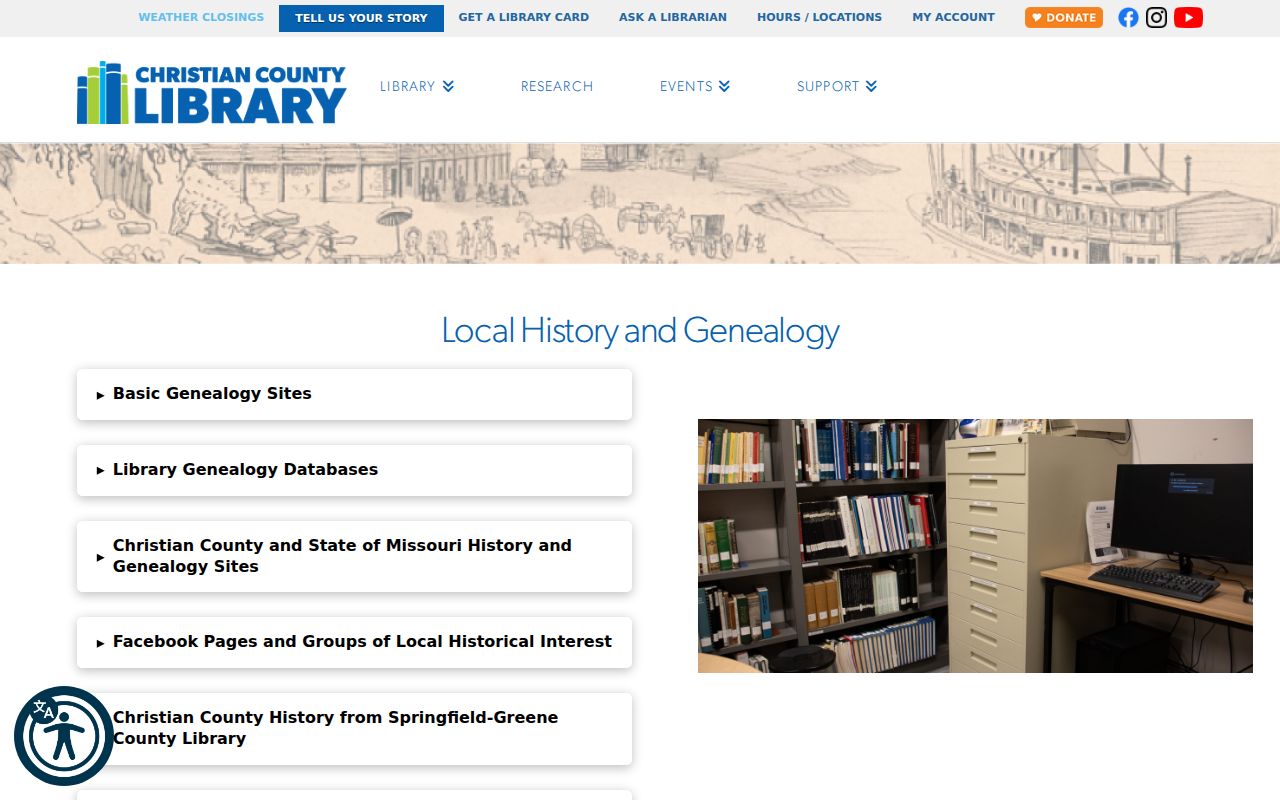
Use its links to locate a primary source or a repository contact, then record the source title and date with the family note.
The Library Center research collections describe the directory, census, newspaper, obituary, and map material available for in-person local-history work.
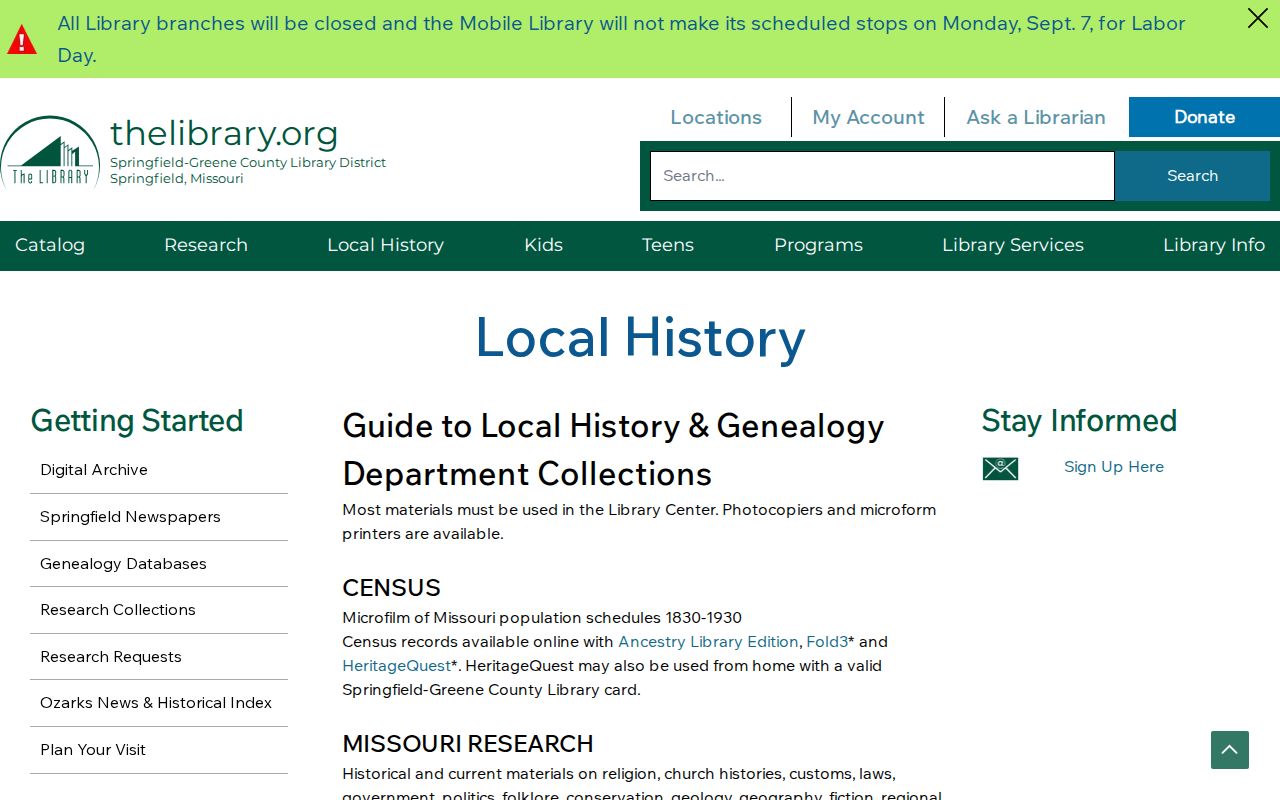
The regional collection is the appropriate place to ask whether a search needs a shelf item, microfilm, a transcription, or a county referral.
Nixa Address-Order Directory Clues
Alphabetical listings answer a name question. A reverse or criss-cross listing begins with a street and dwelling number, then points back to the named person or business recorded at that address. Springfield-Greene Library holds cross-reference material from 1950 through 1970 on microfilm, with later years in closed storage through 2006. It can demonstrate the address-to-name method, but it is not evidence of a Nixa occupant unless the volume itself reaches Nixa.
The digitized Springfield directory collection offers early books that can be searched by keyword. Where a book gives both an alphabetical listing and a street or dwelling index, search both directions. Preserve fractions, directional words, and abbreviations because they distinguish a unit from a nearby address.
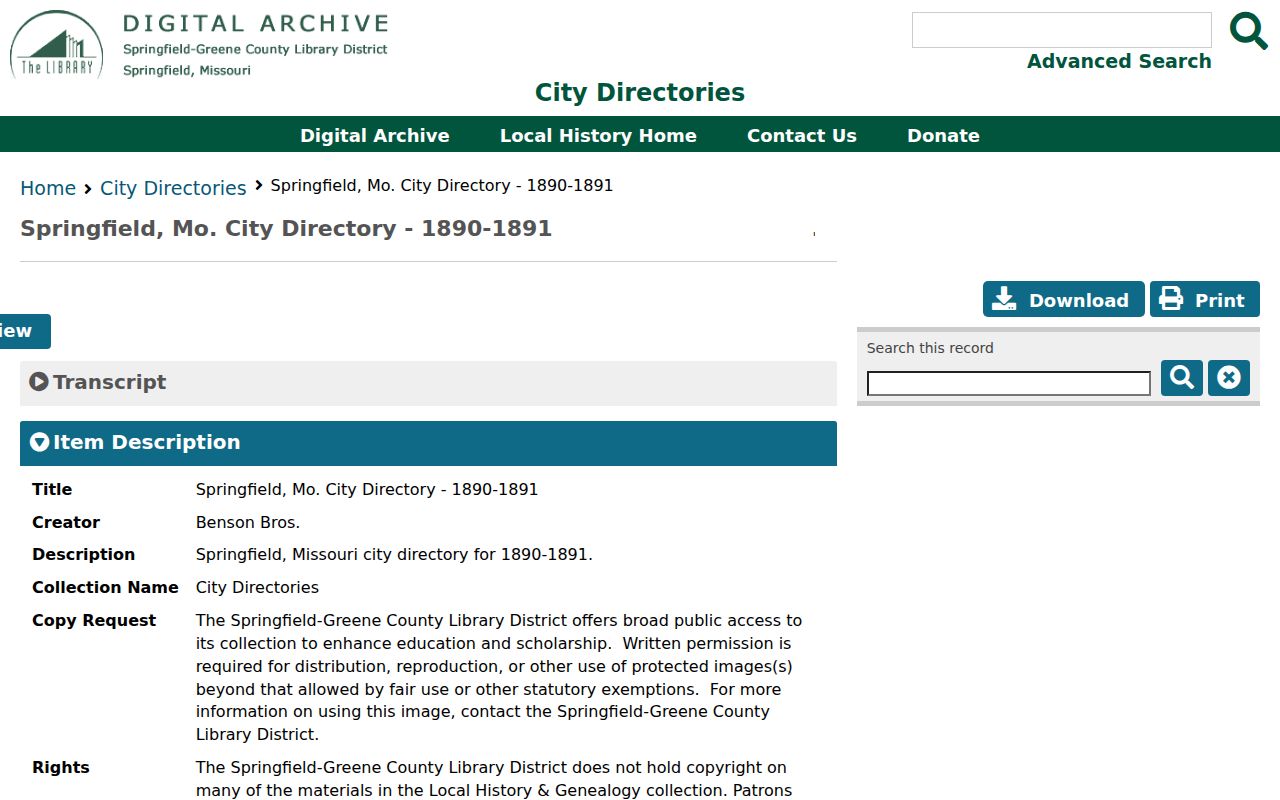
The searchable interface speeds discovery, but the volume's stated geography remains the deciding limit on what the result can prove.
Reading Nixa Directory Entries
The inspected 1905 Springfield transcription is a clear example of the information a regional historical entry can carry. It sits between the 1900 and 1910 federal censuses, so it can supply an intervening date for a person who was not a property owner. It is an adjacent-city sample, not a claim about Nixa coverage. Read its abbreviations and introductory street material before turning a short line into a family conclusion.
| Name | Last name and first name identify the person as transcribed. |
|---|---|
| Occupation | A trade or other occupation may appear beside the name. |
| Residence | A residence indicator and street address may place the entry within the book's stated area. |
| Address detail | A ½ can identify an upstairs or rear living space rather than a separate street number. |
| Business field | The transcription can separately give a business location and business address. |
| Historical classification | The original transcription shows a historical racial-classification field; preserve the source context rather than silently modernizing it. |
The 1905 directory transcription displays its field headings, street-and-alley listing, and abbreviation link before the resident body.
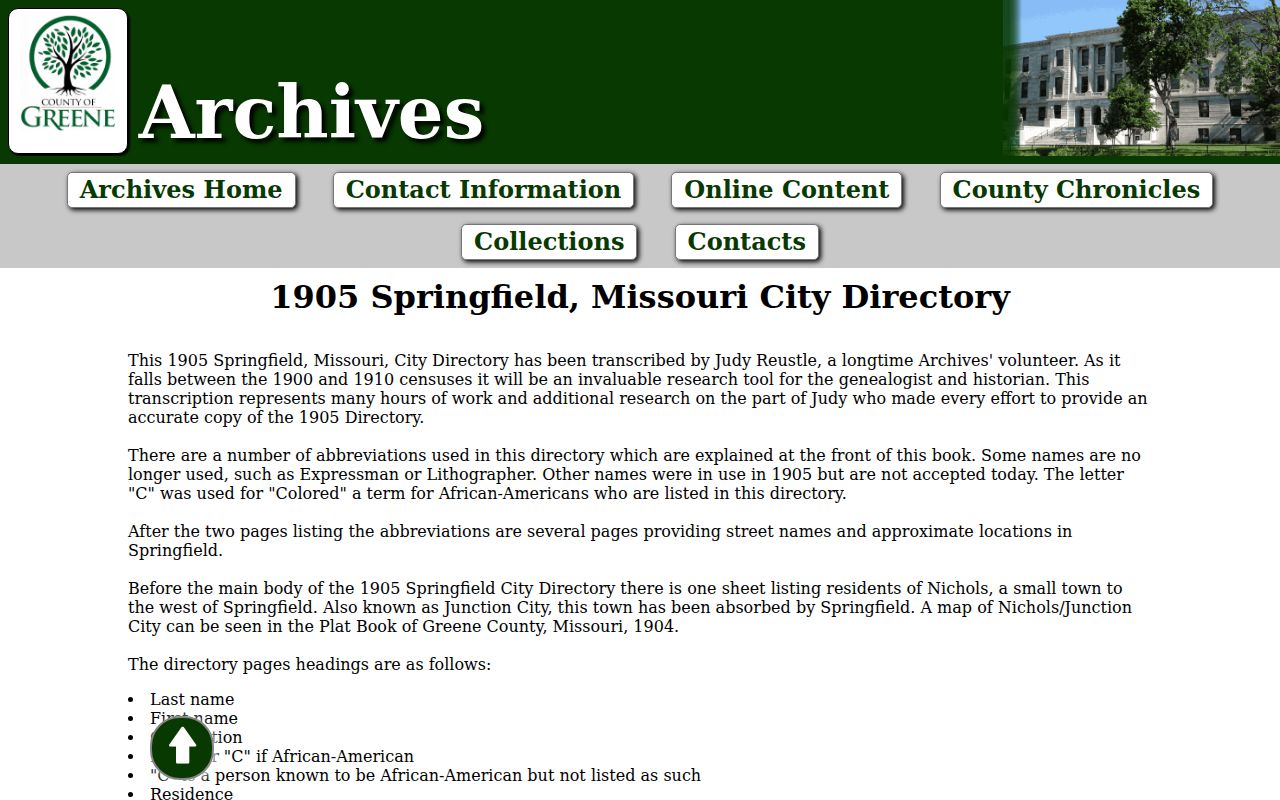
Its separate sections for surnames, streets, alleys, abbreviations, and Nichols Junction show why an entry should be read with the front matter, not in isolation.
- Criss-cross directory
- A reverse listing arranged by street and dwelling number when a volume provides one.
- Householder index
- An alphabetical route to the named household contact; labels and coverage vary by volume.
- Abbreviation key
- The front-matter list explaining the volume's shortened terms, symbols, and address conventions.
Nixa Directory Trail Endpoints
When a person disappears from a historical listing, test more than one explanation. Christian County Library points to local obituaries A–Z, Chronicling America, cemetery resources, land patents, and county transcriptions. Nearby newspaper microfilm and the Dr. William K. Hall index can add a death notice, civic item, marriage notice, or move that a directory alone cannot show.
Obituaries can suggest relatives, a former address, church, military connection, and funeral location. Probate may name an estate fiduciary, heirs, property, and a later conveyance. Cemetery leads include Nokes Cemetery in Nixa and several county cemeteries, but a memorial or notice still needs a date and source check before it is treated as identity proof.
Note: A surname match is only a lead until dates, place, and a second primary or contemporary record agree.
Nixa Directory Landmarks
Early Nixa searches may be indexed by a post-office place, road, landmark, or tract rather than a familiar modern number. The city history places the first residence and post office in 1873, identifies the formal Nixa name in 1881, and describes the 1881 plat around east-west Mount Vernon Road and north-south Main Street. Those are practical orientation points when an old entry resists a modern address search.
The Christian County Museum and Historical Society in Ozark is another local-history route and is identified in the state repository directory as holding original county record books. Confirm current holdings and access arrangements before a visit.
Original county books, a plat, and a dated directory line can work together when an old road or landmark does not match a current street label.
Tracing a Nixa Directory Household
Family history is strongest when each source keeps its own role. A directory may give a name, address, occupation, and a business association for one year. A census is a dated household snapshot. A deed or plat connects land through a legal description. Use the closest census to test the people at the address, but do not expect the same membership because a directory can omit children, boarders, or people outside its delivery area.
- Start with the surname, post-office place, known spouse or initial, and the exact spelling shown in the record.
- Search the next available book and keep the residence, occupation, and address wording exactly as printed.
- Use a street or dwelling listing, if that volume has one, to locate adjacent entries and address fractions.
- Pair the result with the nearest public federal census or Christian County transcription, then compare the date and place.
- Use the 1930 plat, deed reference, obituary, cemetery lead, or probate file to test a move, death, or property connection.
Public federal schedules follow the National Archives 72-year release rule. The research found 1940 public and 1950 released in 2022; 1960 was not public as of the research date. Local Library Center microfilm reaches 1930. For a later transition, a newspaper notice, later deed, or probate filing may be more useful than trying to force an unavailable census into the trail.
Nixa Directory Timeline
Municipal dates explain why the older record trail is sparse and why later parcels and permits become more useful. Keep this chronology beside an address note when a source uses an early landmark or an unfamiliar route.
- 1873: The city history places Nixa's first residence and post office in this year.
- 1881: Nixa received its formal name, and the town plat centered on Mount Vernon Road and Main Street.
- 1902: A village board was established.
- 1945: Nixa incorporated as a fourth-class city on June 7.
- Late 1960s: Sewer construction and the Highway 160 bypass changed the city's later development pattern.
These dates identify context, not a directory series. The safest historical note names the collection, year, place covered, and the separate record used to verify the Nixa connection.