
Nixa Past Residents Sources
One address has several evidence trails. The Christian County GIS parcel service anchors the current parcel, its situs fields, PID, legal description, and deed book or page reference. The Recorder then follows title transfers. Directories and census schedules are household clues for their own dates, while permits date construction or changes. Obituaries and probate can explain a final transfer or a family connection. None of those sources alone produces a complete list of people who lived at the address.
| Source | Years It Covers | Where Held | What It Shows |
|---|---|---|---|
| Christian County Recorder / iCounty | Online start not stated; older books or microfilm as confirmed by the Recorder | Recorder, iCounty, courthouse books or microfilm | Title transfers, parties, legal description, and book or page; not a household roster |
| Christian County GIS / assessor | Current service; historical start not stated | County ArcGIS services | Current parcel, name field, situs, mailing-style fields, PID, deed reference, and legal description |
| Nixa building-permit reports | Detailed 2022–2026; single-family series January 2003–December 2022 | City Building and Development reports | Project and building-change clues; not a promise of an occupant record |
| Springfield criss-cross directories | 1950–1970 microfilm; 1971–2006 closed storage | Springfield-Greene Library Center | Address-to-name clue for the collection's area, not a verified Nixa series |
| Springfield directories | 1878; 1881–1900 reproductions; 1901–1969 microfilm; 1970–present closed storage | Springfield-Greene Library Center | Name, street, and historical-affiliation clues, subject to geographic coverage |
| Federal census | Public schedules follow the 72-year rule; local microfilm inspected through 1930 | Library, archives, and NARA routes | Dated household snapshot, not a current-address source |
| Christian County archival rolls | Selected births 1840–1904, deaths in listed 1880s and 1895 years, poll tax 1905–1920, and 1876 census | Missouri State Archives and local repositories | Historic local clues in discontinuous series |
Start with GIS for a modern address, then use the deed reference and legal description to move backward. Start with an old person or road name in the library and archive routes, then work forward toward a parcel. The records converge only after the place, date, and person line up.
Nixa Past Residents Start at PID
The parcel identifier is the stable handoff between an address search and a historical property trail. The county map exposes a parcel number or PID, name field, address fields, situs street and city, subdivision, acreage, section, township, range, legal description, and deed book or page. The name field and mailing-style address fields are not proof that every person connected to the parcel lives there.
Record the situs address and city-limit context separately from a postal label. Then retain the legal description, lot or block, subdivision, and deed reference. This prevents an old number, a tract split, or a rural-style description from breaking the search.
- Address or old road name
- County GIS parcel and PID
- Legal description and deed book or page
- Recorded transfer and prior party
- Directory, census, permit, obituary, or probate check for the dated household trail
Nixa Past Residents Deed Chain
Title research begins with the current parcel and moves backward one transfer at a time. The Recorder's instructions require grantors, grantees, a document title and date, statutory addresses, a legal description, and prior book or page references when required. A street address is useful for finding the property, but it is not accepted as the legal description. Use the legal description to keep the search tied to the same tract.
- Capture the GIS PID, situs, subdivision, legal description, deed book or page, and the current name field.
- Find the current acquisition in the recorder index and record the buyer, seller, instrument type, date, document number, and prior reference.
- Search the seller as a grantee to locate that person's earlier acquisition, then compare the legal description.
- Repeat the transfer sequence, checking spouse initials, trustee roles, corporate names, recording dates, and lot or tract language where a name is common.
- When online coverage no longer reaches the needed record, ask the Recorder which deed books, microfilm, or courthouse volumes cover the gap.
The Christian County Recorder iCounty landing page identifies the Recorder and the available registration and subscription paths.
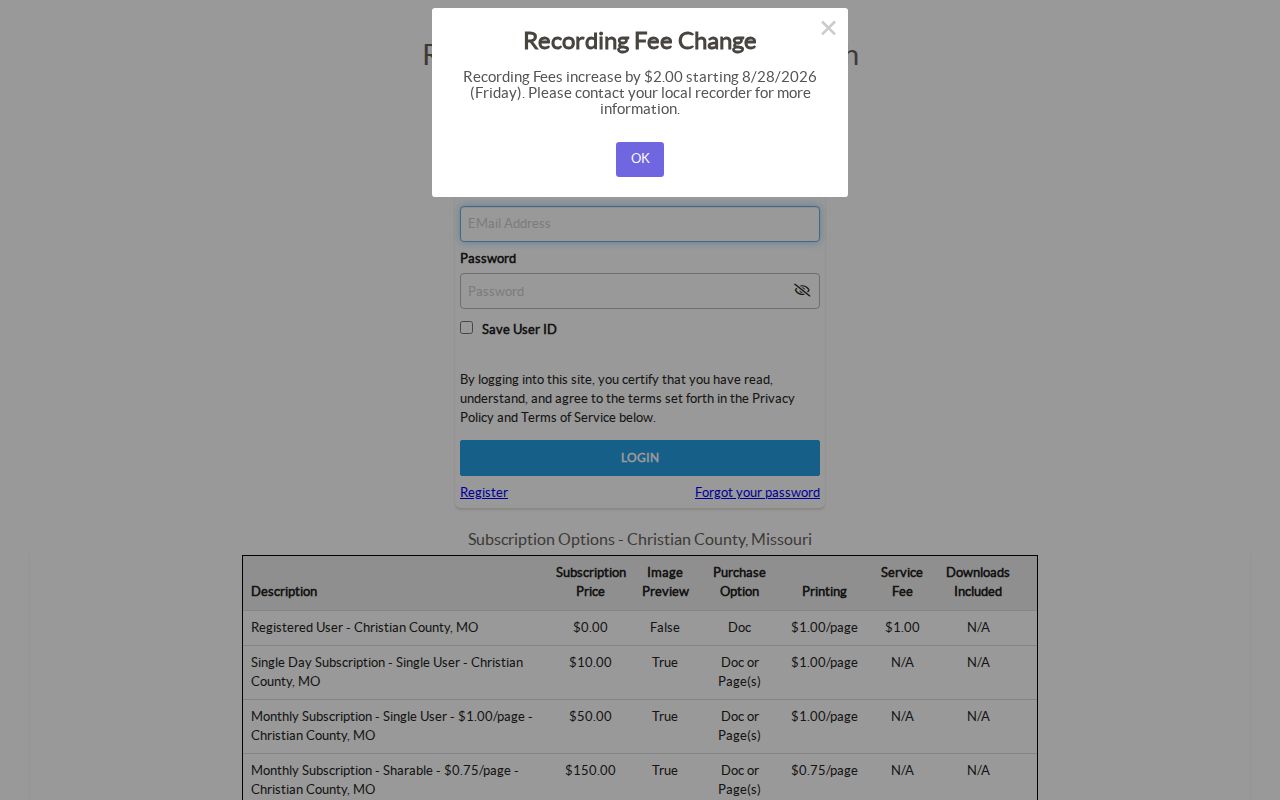
An index result or an instrument proves a title event. It does not by itself establish who occupied the address during that period.
- Grantor / grantee
- The grantor transfers an interest; the grantee receives that interest in the recorded instrument.
- Chain of title
- The linked sequence of transfers for the same parcel or tract, traced from one instrument to the prior one.
- Legal description
- The lot, block, subdivision, or metes-and-bounds description that identifies land more reliably than a changing street number.
- Criss-cross directory
- An address-order listing that can supply a dated name clue where the collection actually covers the location.
Nixa Past Residents Index Gap
The inspected iCounty landing page requires an email and password before the deed-search controls appear. It does not state the online index's first year or imaging cutoff. That means an exact beginning year should not be assumed. The Recorder's office at 100 W. Church St., Room 104, Ozark, is the documented fallback for older books and access questions; call to confirm public-terminal hours and historical-volume access.
The access terms distinguish index access from image access. Registered access is listed at no cost without image preview, while printing is listed at $1 per page plus a $1 service fee. A single-day, single-user subscription is listed at $10 with image preview and $1-per-page printing. The landing page does not establish whether a name search is free after login or which result fields appear before an account is used.
Note: Record the book, page, document number, and legal description before relying on a screen image or a typed name match.
Nixa Past Residents Address Continuity
Nixa's 1881 plat centered on east-west Mount Vernon Road and north-south Main Street. Older deeds and local references may instead use a rural route, post-office place, landmark, later street name, or tract description. The City Community Map distinguishes city boundaries, lots and addresses, subdivisions, zoning, and street names. Use it with county GIS before treating a Nixa mailing address as incorporated-city land.
No official Nixa address-renumbering bridge, annexation conversion table, or historic ZIP boundary change was located. The research documents a 1947 renumbering in Springfield only, so it cannot be applied to Nixa. When a modern number fails, search the old road name, nearby landmark, subdivision or lot, and legal description before deciding the prior owner is absent.
Nixa Past Resident Household Records
Title and occupancy are different questions. For each owner interval, test a directory, public census, permit report, obituary, or probate file according to its date. Christian County Library directs researchers to county plats, deeds, newspapers, obituaries, cemeteries, and historical-source collections. Springfield-Greene Library has the nearest documented criss-cross, city-directory, census, newspaper, and obituary material, but its directory holdings are not a verified Nixa run.
The Library Center research collections show the regional directory, census, map, newspaper, and obituary resources used to test a dated address trail.
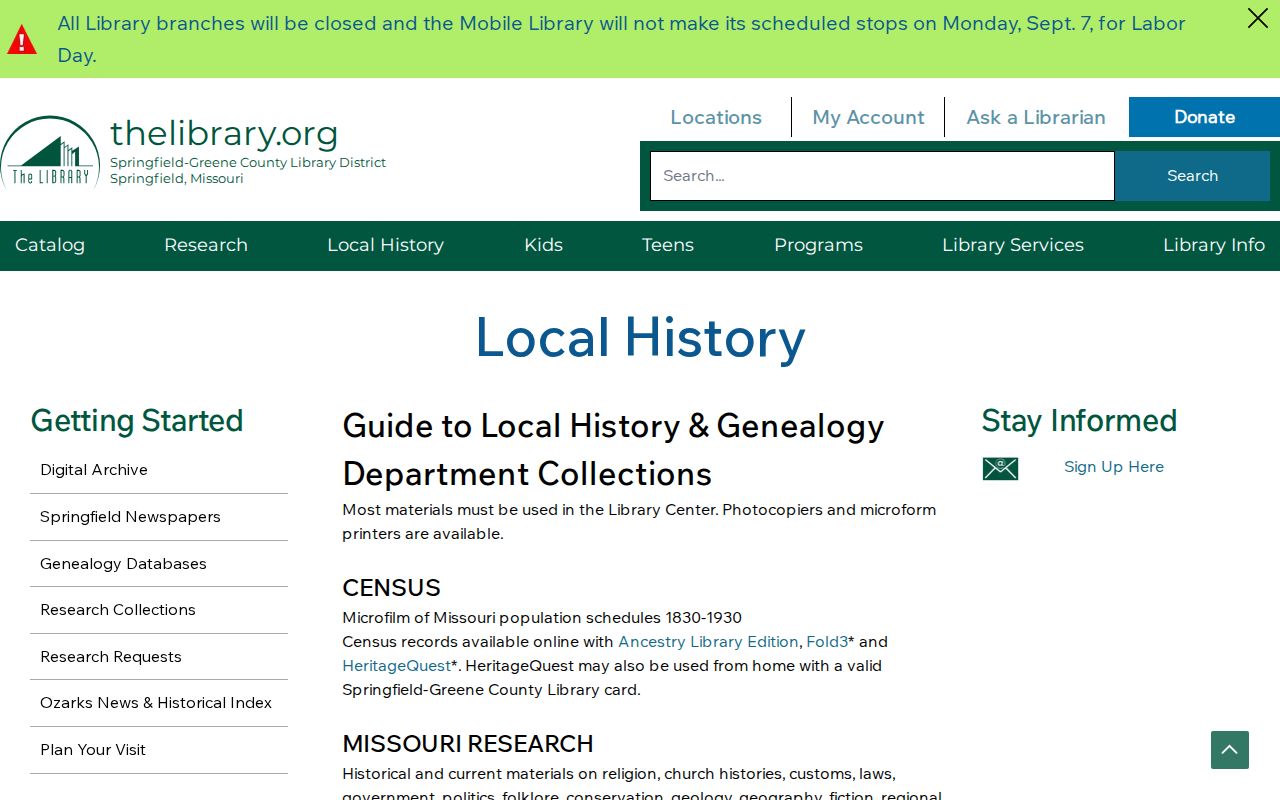
Use the local-history desk to identify the right format, then verify whether the material's geographic scope reaches the Nixa address.
The digitized Springfield directory collection permits keyword searching in selected early books and may reveal how a name or street was recorded in the region.
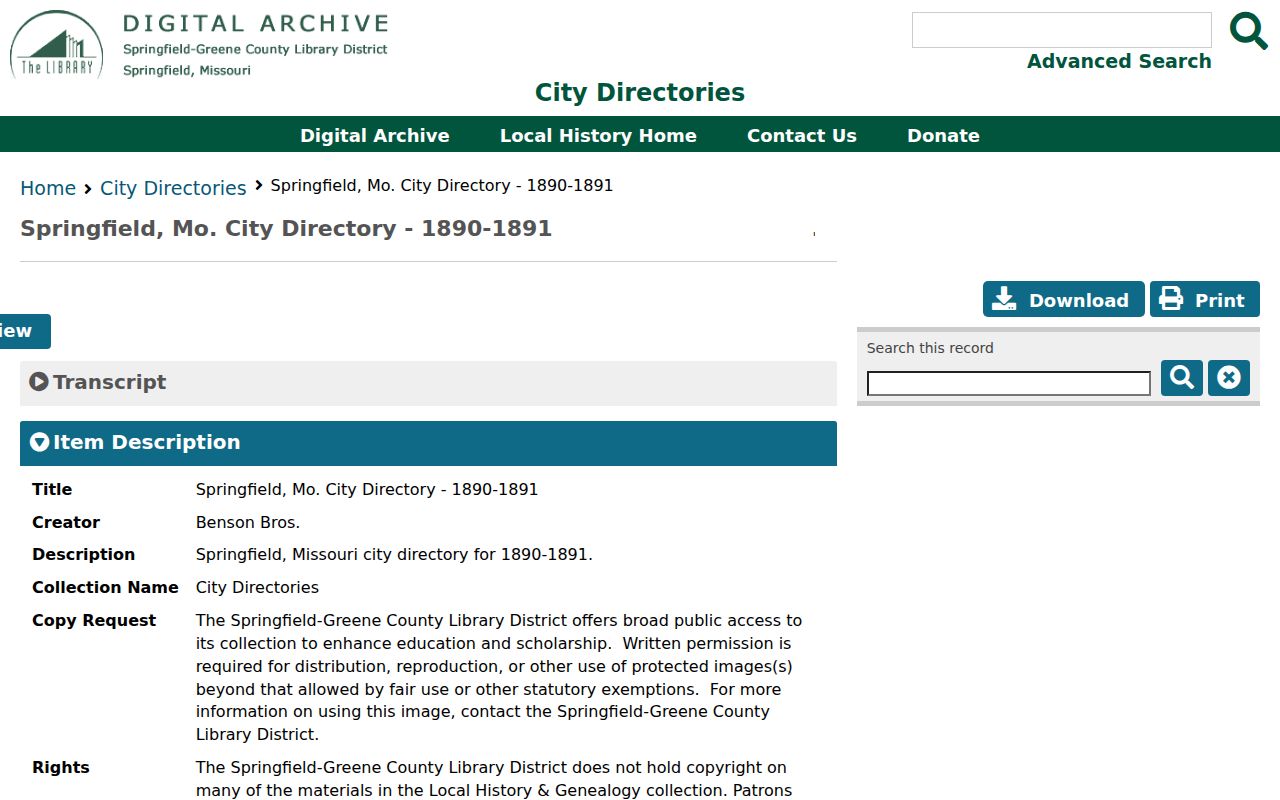
A keyword hit is a lead. The volume title and the address context decide whether it belongs in a Nixa history.
The 1905 Springfield directory transcription makes its surname sections, street-and-alley listing, and abbreviations visible for comparison.
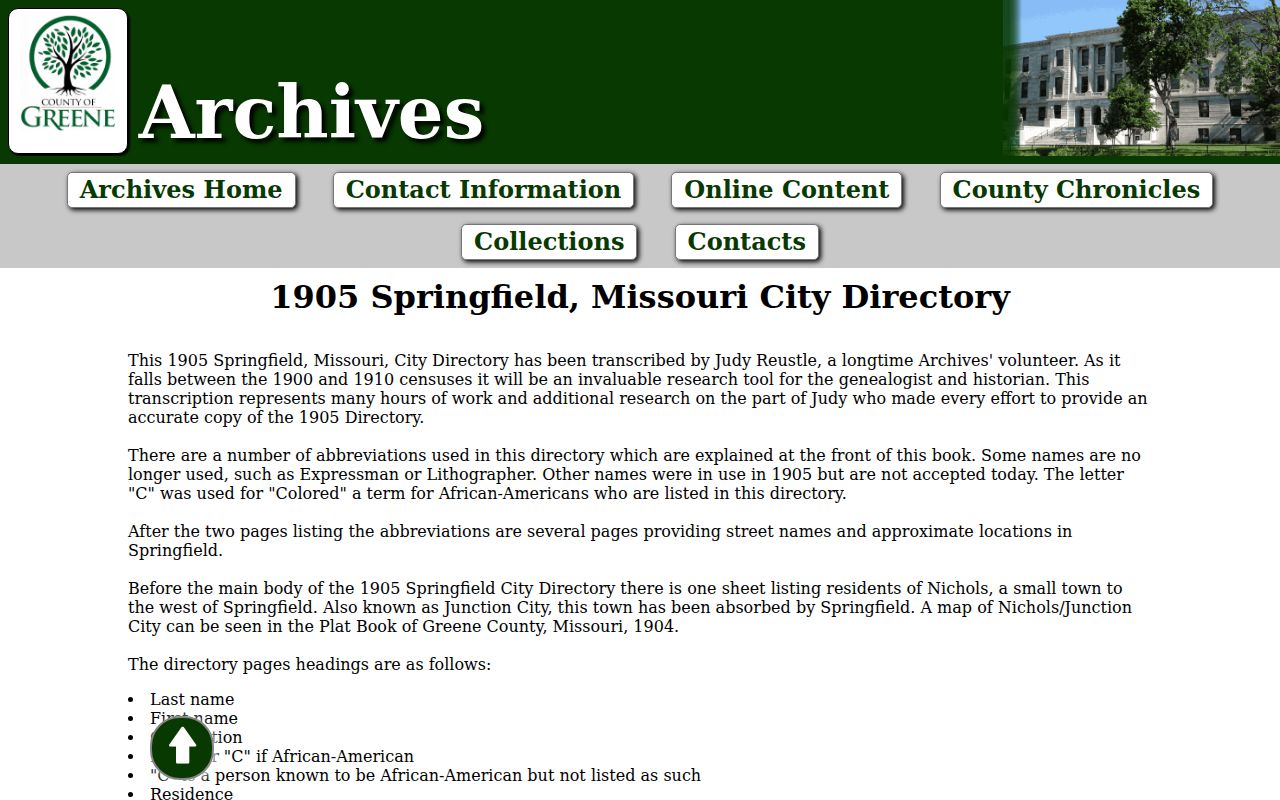
Its residence, occupation, business-address, and address-fraction fields show why historical entries must be read in their original context.
- Write the deed interval and the address or legal description beside the directory year.
- Search the name and, where available, the street or dwelling listing; preserve abbreviations and fractions.
- Pair the result with the nearest released federal census, Christian County transcription, or 1876 state census clue.
- Compare the household date, locality, and address wording before adding a person to the address history.
Nixa Permit Trail Dating
Nixa building-permit reports are an address-history bridge, not a resident list. The city publishes detailed monthly reports for 2022 through 2026 and a 20-year single-family series from January 2003 through December 2022. The reports can point to construction, additions, garages, fences, demolitions, and other project history. A permit may date a change to the building without naming every person who lived there.
For an older or address-specific file that is not posted, request the record from the city with the street address, parcel or PID, time period, and document type. Planning and zoning files can also add annexation, plat, rezoning, easement, right-of-way, and development dates when a subdivision changed the legal description.
Nixa Past Residents Trail Endpoints
When an owner died or a title transfer seems abrupt, close the trail with a dated obituary and the related probate or recorded conveyance. Christian County Library links local obituaries A–Z, cemetery resources, historic newspaper routes, and Christian County transcriptions. Funeral-home archives can identify relatives, former addresses, church connections, military affiliation, and funeral location. Treat those details as leads until they match the relevant record.
Christian County probate is handled by the Circuit Clerk's Probate division. Case.net can provide public case headers, while older files and copies require the clerk. Probate can identify a fiduciary, heirs, estate property, and an eventual transfer. State Archives material adds discontinuous county anchors such as listed birth, death, poll-tax, road, court, and 1876 census records.
Note: An obituary and a deed answer different questions, so preserve both dates instead of replacing one with the other.
Nixa Past Resident Households
For a person who lived at an address without holding title, the household trail matters most. Federal population schedules are public after the National Archives 72-year release period. The research found 1940 public and 1950 released in 2022, while the nearest inspected local microfilm reaches 1930. A census is a one-date snapshot and can omit or include people differently than a directory.
Use a public directory or census result with the deed interval, not in place of it. The historical volumes and their geographic limits are described on the Nixa city directory page. Add a newspaper, cemetery, or probate check when the household appears to leave, die, or transfer property. Keep a person's connection to the address qualified by the source and year.
Lawful use. Use a Nixa address trail for personal house history, family history, estate matters, or civic curiosity. Do not use public material to stalk, harass, harm, or expose anyone, especially a person with a protected address.